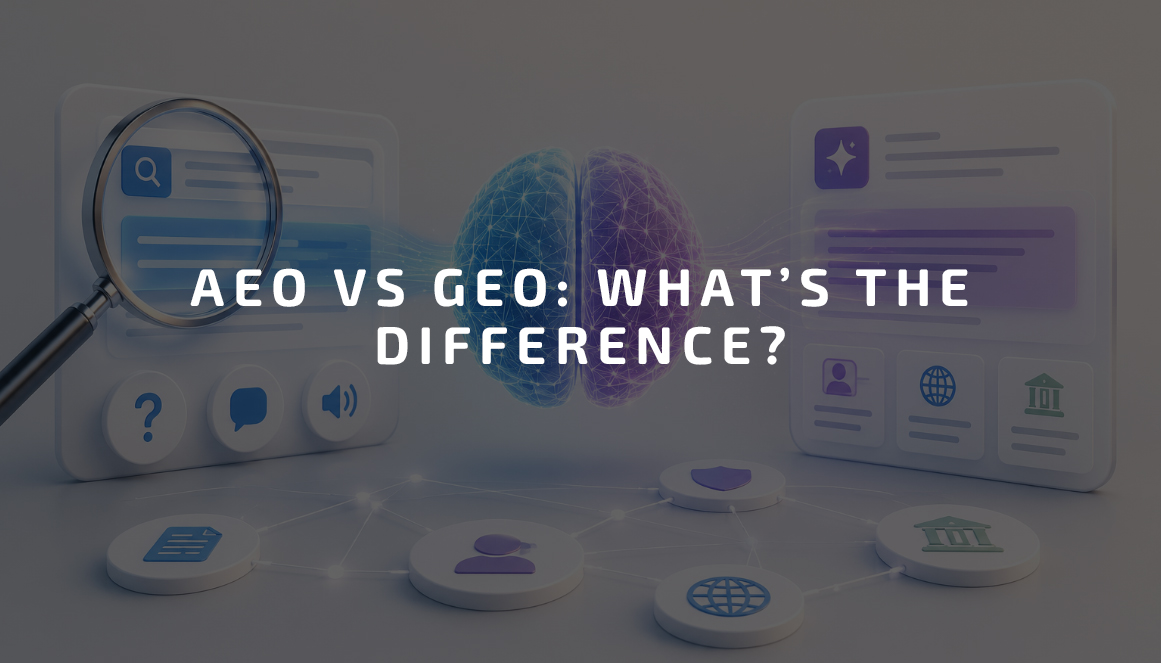
The Shift from Search Engines to Answer & Generative Systems
Search is evolving beyond ten blue links. Modern platforms increasingly provide synthesized answers, reducing the need for users to visit multiple pages.
Google integrates AI-generated summaries directly into search results.
Microsoft incorporates generative answers into Bing.
This transformation requires new optimization frameworks: AEO and GEO.
What Is Answer Engine Optimization (AEO)?
AEO is designed to help content surface in:
- Featured snippets
- Voice search results
- “People Also Ask” boxes
- Direct AI answers
Core AEO Principles
- Provide concise, structured responses
- Use clear question-based headings
- Deliver definitions within the first paragraph
- Implement FAQ schema
- Format lists and tables for extractability
AEO works best for:
- Definitions
- Step-by-step instructions
- Comparisons
- Short factual queries
It rewards clarity and precision.
What Is Generative Engine Optimization (GEO)?
GEO focuses on how AI systems synthesize information from multiple sources to produce contextual responses.
Instead of extracting a single paragraph, generative engines:
- Analyze topic breadth
- Evaluate domain authority
- Detect entity relationships
- Weigh credibility signals
GEO is less about formatting a single answer and more about building ecosystem-level authority.
Core GEO Principles
- Develop comprehensive topic clusters
- Strengthen internal linking architecture
- Earn authoritative backlinks
- Maintain consistent entity associations
- Publish expert-level analysis
GEO rewards depth, authority, and semantic richness.

AEO vs GEO: Direct Comparison
| Aspect | AEO | GEO |
| Primary Goal | Be extracted as a direct answer | Be cited or synthesized in AI summaries |
| Content Style | Concise and structured | Comprehensive and authoritative |
| Best For | Informational queries | Complex, multi-layered queries |
| Key Signals | Clear formatting, schema markup | Topical authority, backlinks, brand trust |
| Measurement | Snippet visibility, voice results | AI citations, brand mentions, SERP feature dominance |
Strategic Differences in Practice
Content Depth
- AEO: One page can rank if it answers clearly.
- GEO: Requires interconnected content across a topic ecosystem.
Authority Signals
- AEO: Page-level optimization matters most.
- GEO: Domain-level authority becomes critical.
User Intent Handling
| Query Type | AEO Advantage | GEO Advantage |
| “What is…” | Strong | Moderate |
| “How to…” | Strong | Strong |
| Strategic analysis | Limited | Strong |
| Industry comparisons | Moderate | Strong |
Why Businesses Need Both AEO and GEO
Answer Engine Optimization delivers immediate tactical wins. When content is clearly structured and directly responds to user questions, it can be extracted into featured snippets, voice results, or AI-generated summaries. This creates rapid visibility, even without holding the #1 organic position.
Generative Engine Optimization, in contrast, operates at a broader strategic level. It strengthens a website’s authority across an entire topic ecosystem. Rather than optimizing a single paragraph for extraction, GEO builds a network of interconnected, in-depth content that signals expertise and reliability. Over time, this creates defensibility: AI systems are more likely to reference domains that consistently demonstrate authority.
Focusing exclusively on AEO can make visibility fragile. If search interfaces evolve or extraction patterns shift, heavily formatted but shallow content may lose prominence. On the other hand, relying only on GEO can mean missing short-form extraction opportunities where concise, well-structured answers dominate.
An integrated approach bridges this gap. Businesses should:
- Provide clearly extractable definitions and summaries for high-intent queries.
- Support those answers with deep, authoritative topic clusters.
- Implement structured data to enhance machine readability.
- Reinforce credibility through strong internal linking and external authority signals.
In practical terms, AEO wins the answer box; GEO wins the ecosystem.
Measuring Success in AEO and GEO
Traditional SEO performance metrics—primarily rankings and organic traffic—no longer provide a complete picture. In AI-influenced SERPs, visibility can exist even when clicks decline.
Success measurement must therefore expand beyond position tracking.
Key indicators now include:
- Ownership of featured snippets and direct answer placements
- Frequency of domain citations within AI-generated summaries
- Growth in branded search queries
- Engagement metrics from informational traffic
- Overall presence across SERP features (snippets, AI blocks, People Also Ask, knowledge panels)
Visibility is becoming layered rather than linear. A site may not rank first organically, yet still dominate user attention through answer extraction or generative citation. This shift requires evaluating exposure, not just traffic volume.
The Future of Optimization
As AI systems continue to evolve, their evaluation models will increasingly prioritize credibility and contextual integrity. Rather than matching keywords mechanically, they assess whether a source consistently demonstrates expertise within a topic domain.
Several trends are becoming clear:
- Trust signals will outweigh aggressive keyword targeting.
- Consistent authorship and demonstrated expertise will influence citation likelihood.
- Contextual clarity—how well ideas connect across a site—will matter more than isolated pages.
- Real-world authority (brand recognition, editorial mentions, subject-matter expertise) will strengthen inclusion in generative outputs.
Optimization is gradually shifting from keyword engineering toward knowledge architecture. The most competitive websites will not simply answer questions—they will structure information in a way that machines can interpret as authoritative and interconnected.
Businesses that invest in semantic architecture, credible branding, and sustained topical depth will be positioned to dominate both answer engines and generative engines. In an environment where information is synthesized rather than merely indexed, structured expertise becomes the primary competitive advantage.