Does Content Length Really Affect SEO?
A 3,000-word guide can rank below a 400-word article. Adding more paragraphs will not automatically close that gap.
Google’s SEO documentation explicitly states that content length alone does not determine rankings. There is no minimum or ideal word count.
Research supports this distinction. Backlinko analyzed 11.8 million Google search results and found no direct relationship between word count and rankings among first-page results.
The real question is whether a page answers the search query thoroughly enough without making visitors work through unnecessary information.
When Long-Form Content Wins
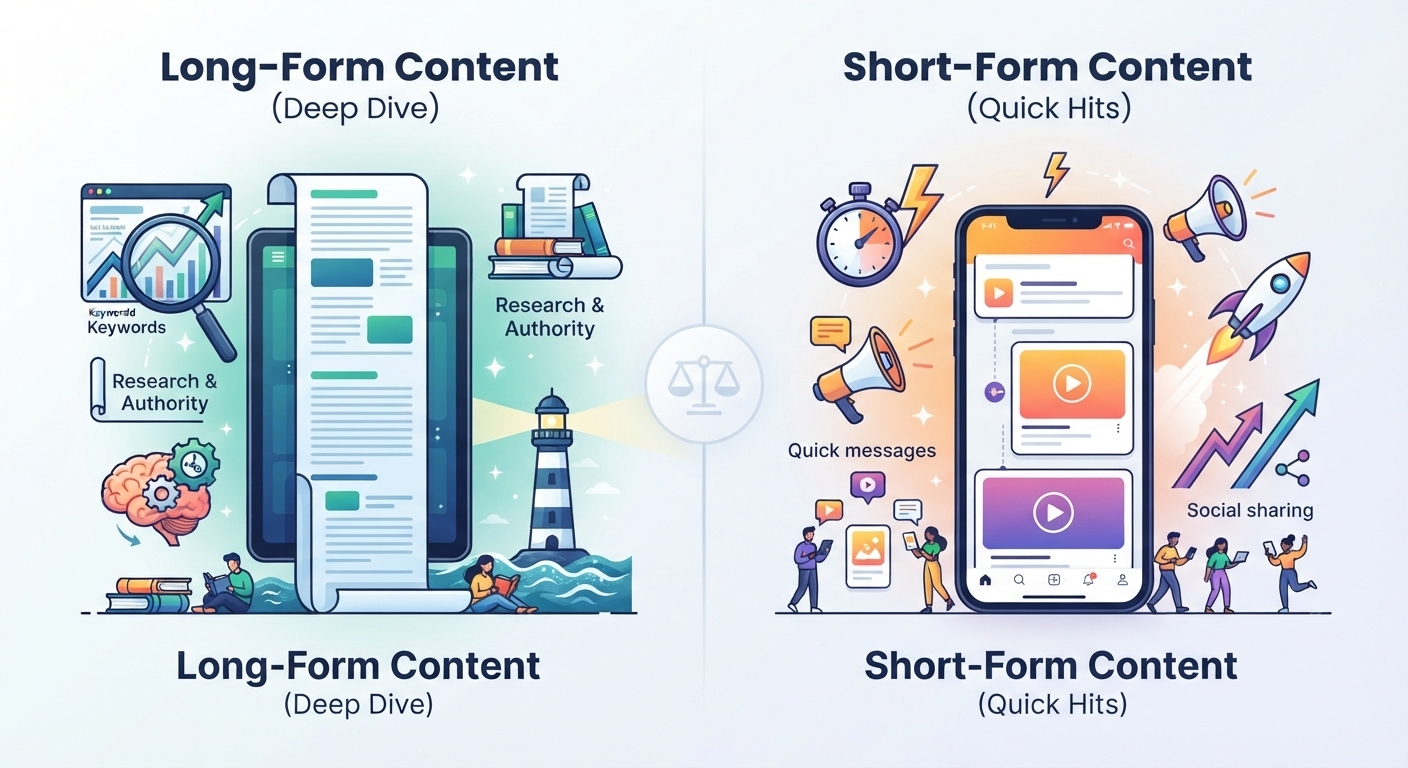
Long-form content commonly exceeds 1,000 words, although definitions vary. Its advantage comes from the amount of useful information it can accommodate.
Complex Questions Need More Explanation
Consider someone searching for “how to migrate an ecommerce website without losing SEO traffic.”
A brief answer cannot adequately cover redirect mapping, URL structures, staging environments, analytics, and post-launch monitoring.
A detailed guide can address these steps in a logical sequence, reducing the need for additional searches.
Detailed Research Creates Linking Opportunities
Original studies, technical tutorials, and comprehensive comparisons may attract links because other publishers can reference their findings.
However, length itself does not make research valuable. A 900-word article containing original data may offer more value than a 4,000-word summary of existing advice.
Long-form content is particularly useful for:
- Technical tutorials involving several stages.
- Buying guides comparing multiple products.
- Research reports containing original findings.
- Educational resources covering connected questions.
When Short-Form Content Wins
Short pages work well when visitors need a specific answer rather than a complete lesson.
Someone searching for “what is a canonical URL” may only need a definition, a short example, and an explanation of its purpose.
Adding 2,000 words about SEO history would delay the answer.
Short-form content is also suitable for commercial pages where product specifications, availability, pricing, and purchasing options matter more than lengthy explanations.
For example, a replacement laptop battery page should prioritize compatibility, capacity, warranty details, and ordering information.
A concise page covering these details can satisfy the query better than an extended article about battery technology.
Long-Form vs Short-Form: Practical Comparison
| Search intent | Recommended format |
|---|---|
| “What is bounce rate?” | Short explanation |
| “How to conduct a technical SEO audit” | Detailed guide |
| “iPhone 16 battery replacement cost” | Concise service page |
| “Best CRM platforms compared” | In-depth comparison |
These are starting points, not fixed rules. Actual search results may reveal different expectations.
How to Choose Content Length Before Writing
Start with the query, not a word-count target.
- Inspect the SERP. Check whether competing results are guides, product pages, videos, or concise answers.
- Identify the user’s next action. Are they learning, comparing alternatives, or ready to buy?
- List essential information. Include everything required to resolve the question.
- Remove unnecessary sections. If a paragraph does not support the page’s purpose, reconsider it.
- Measure performance. Use Google Search Console to compare impressions, clicks, and relevant queries after publication.
Suppose a 600-word tutorial attracts impressions but misses searches about troubleshooting. Adding a tested troubleshooting section may improve its usefulness.
Expanding every paragraph merely to reach 1,500 words is unlikely to produce the same benefit.
What Research Says About AI Search
Content length is not a reliable shortcut for AI visibility either.
An Ahrefs study examining 174,048 pages cited in Google AI Overviews found that 53.4% contained fewer than 1,000 words.
The study also reported a near-zero correlation between word count and citation inclusion.
This does not prove shorter articles perform better. It suggests that both formats can earn citations when their information is relevant.


