Pay-per-click advertising in 2026 is no longer about increasing bids or expanding keyword lists. ROI growth now depends on precision, automation, and data ownership. Rising competition, AI-driven platforms, and privacy limitations are reshaping how profitable PPC campaigns are built.
To stay competitive and maximize ROI in 2026, advertisers must rethink how they plan, launch, and optimize paid campaigns. Below are five PPC trends that will define high-performing strategies in the coming year.
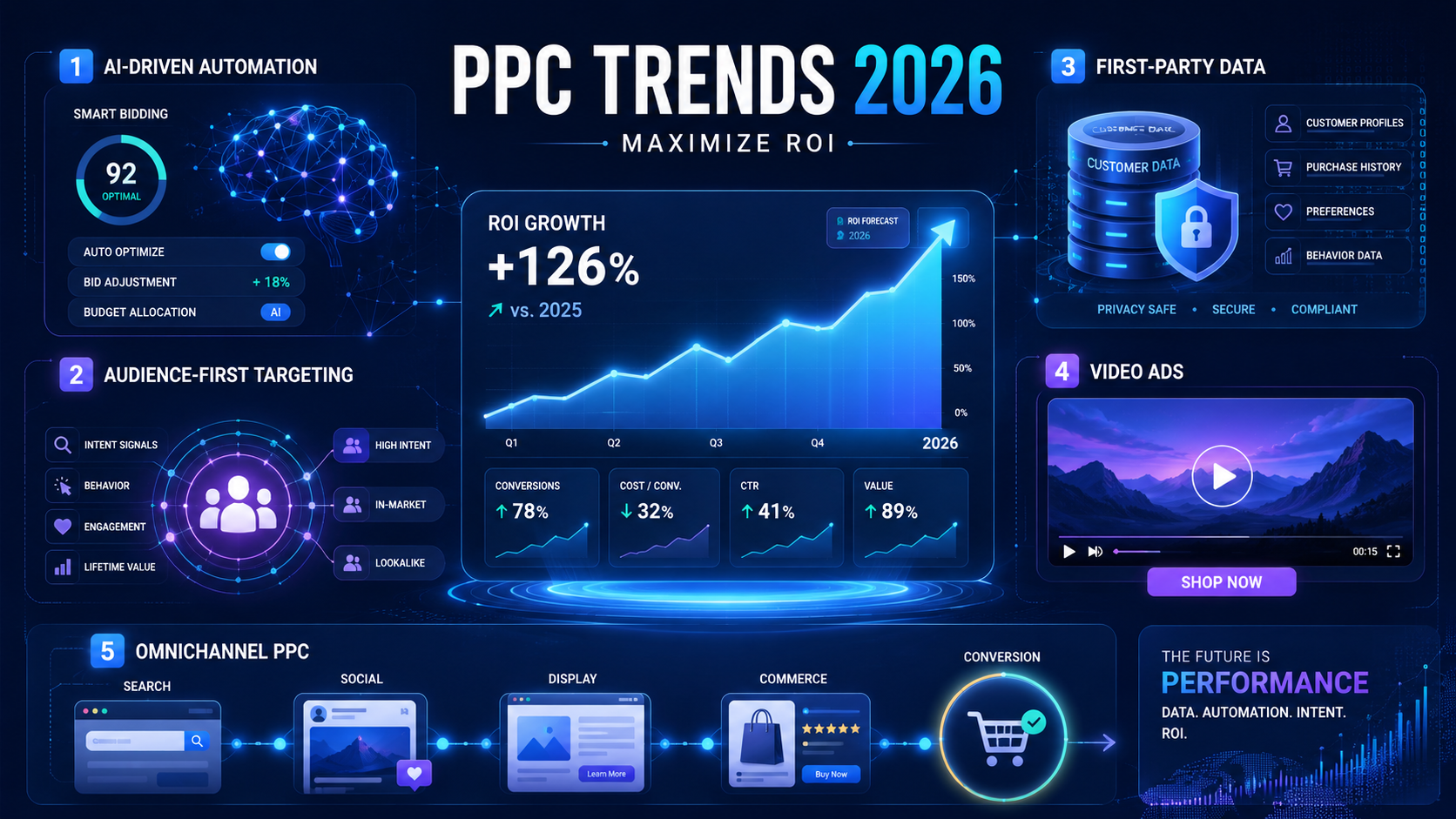
AI-Driven Campaign Automation Becomes the Standard
Manual PPC management is losing efficiency. In 2026, AI-powered automation is no longer optional — it’s the foundation of profitable campaigns.
Ad platforms increasingly rely on machine learning to handle bidding, targeting, and creative optimization in real time. AI systems analyze thousands of signals simultaneously, adjusting bids and placements faster than any human team.
ROI impact:
Automation reduces wasted spend, improves conversion efficiency, and frees teams to focus on strategy rather than micromanagement.
AI Application | Primary Benefit | ROI Effect |
Smart bidding | Real-time bid optimization | Lower CPA |
AI creatives | Faster ad testing | Higher CTR |
Automated budgets | Spend efficiency | Reduced waste |
Audience-First Targeting Replaces Keyword Dependency
Keywords still matter, but in 2026 they no longer drive performance alone. Successful PPC campaigns prioritize who sees the ad, not just what they search.
Audience-first targeting uses behavioral data, demographics, and intent signals to identify high-value users. This approach allows advertisers to reach buyers earlier and guide them through the funnel more efficiently.
ROI impact:
Fewer irrelevant clicks, higher-quality traffic, and stronger conversion rates.
Targeting Layer | Purpose | Outcome |
In-market audiences | Capture buying intent | Higher CVR |
Remarketing | Re-engage warm users | Lower CPA |
Customer lists | Match real buyers | Improved ROAS |
First-Party Data Becomes a Competitive Advantage
With third-party cookies disappearing, first-party data is the most valuable asset in PPC. Email lists, CRM data, and purchase history now fuel smarter AI optimization.
Platforms learn faster and make better decisions when campaigns are trained on real customer behavior rather than anonymous signals.
ROI impact:
Better attribution, stronger audience matching, and higher lifetime value.
Best first-party data sources:
- CRM and sales databases
- Newsletter subscribers
- Past purchasers and lead forms
Advertisers who invest in data collection and integration in 2026 will outperform competitors who rely on platform defaults.
Video Ads Drive Direct Conversions, Not Just Awareness
Video PPC is no longer limited to branding. Short-form, high-impact videos are now optimized for immediate action.
Users are increasingly comfortable purchasing directly from video ads, especially on mobile-first platforms. The key is concise storytelling and a clear call-to-action within the first few seconds.
ROI impact:
Higher engagement rates and stronger assisted conversions across the funnel.
Video Format | Ideal Length | Best Use |
Short-form video | 6–15 seconds | Fast conversions |
Product demos | 15–30 seconds | Consideration |
Testimonials | 20–30 seconds | Trust building |
Omnichannel PPC Strategies Outperform Single-Platform Campaigns
Relying on one advertising platform is risky and inefficient. In 2026, ROI growth depends on omnichannel PPC strategies that cover search, social, and commerce-driven platforms.
Users rarely convert after a single interaction. Profitable campaigns support the entire journey — from discovery to purchase — across multiple touchpoints.
ROI impact:
Higher conversion probability and better budget resilience.
Channel roles in an omnichannel strategy:
- Search: capture active demand
- Social: generate interest and remarketing pools
- Commerce platforms: close high-intent buyers
Final Thoughts: PPC ROI in 2026 Is Built on Strategy, Not Spend
Maximizing ROI in 2026 requires smarter systems, cleaner data, and a deeper understanding of user intent. AI, first-party data, video, and omnichannel execution are not trends to watch — they are requirements for sustainable growth.
Advertisers who adapt early will gain efficiency, reduce acquisition costs, and turn PPC into a predictable revenue channel rather than a variable expense.
If your goal is ROI growth, the time to evolve your PPC strategy is now.
FAQ: PPC Trends and ROI in 2026
The most impactful PPC trend in 2026 is AI-driven automation combined with first-party data. AI optimizes bids, creatives, and targeting in real time, but its effectiveness depends on the quality of data you provide. Advertisers who feed platforms with real customer data consistently achieve higher ROAS and lower CPA.
Yes, keywords are still relevant, but they are no longer the primary driver of performance. In 2026, audience signals, intent data, and behavior patterns play a bigger role. Keywords help trigger ads, while audiences determine who actually sees them and converts.
First-party data allows ad platforms to learn from real purchase behavior, not assumptions. This improves:
- audience matching accuracy
- conversion prediction
- bidding efficiency
As privacy regulations increase, first-party data becomes essential for maintaining stable PPC performance and ROI.
While not mandatory for every niche, video advertising significantly boosts engagement and conversion support. Short-form video ads are particularly effective for:
- mobile users
- remarketing audiences
- product demonstrations
Brands that ignore video risk losing attention and conversion opportunities.
Omnichannel PPC reaches users at different stages of the buying journey. Instead of relying on one platform, advertisers:
- reduce dependency on algorithm changes
- improve attribution accuracy
- increase total conversion probability
This approach leads to more stable and scalable ROI growth.


