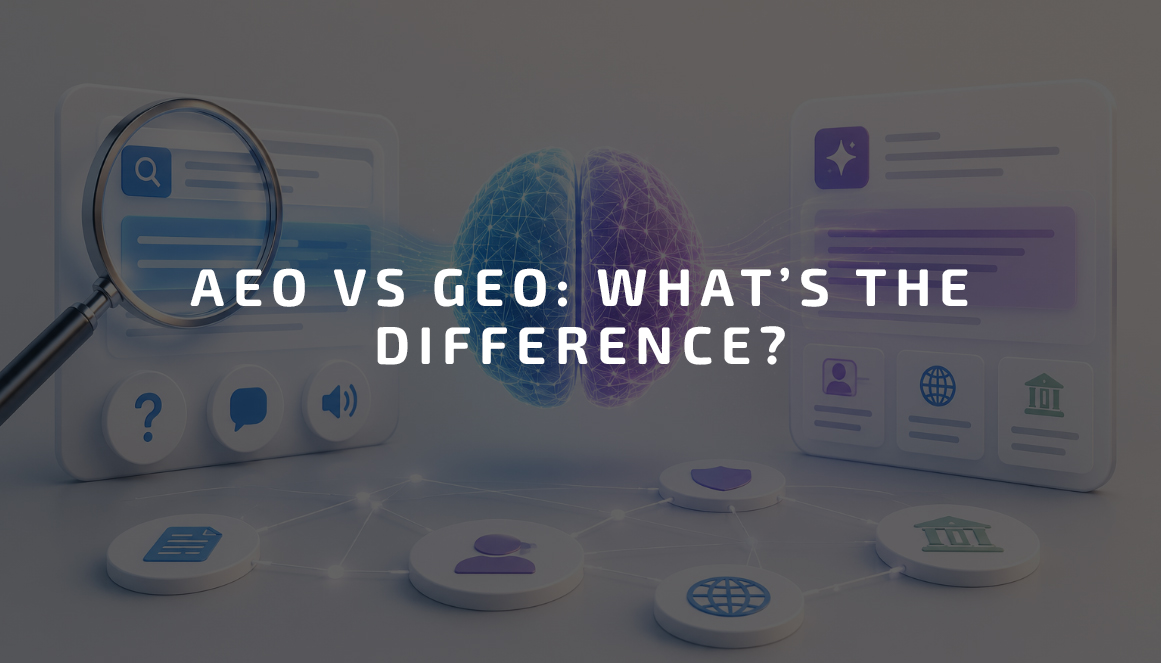
The Shift from Search Engines to Answer & Generative Systems
Search is evolving beyond traditional lists of links. Google AI Overviews, ChatGPT Search, and other AI-powered platforms increasingly provide direct answers and synthesized information.
Users can now research topics, compare solutions, and discover brands without visiting multiple websites.
This creates two complementary optimization priorities: making content easy to extract as an answer (AEO) and making it valuable enough to reference in AI-generated responses (GEO).
What Is Answer Engine Optimization (AEO)?
AEO focuses on structuring content so search and answer systems can identify clear, relevant responses to user questions.
It supports visibility in:
- Featured snippets
- Voice search answers
- People Also Ask results
- Direct AI-powered answers
Core AEO Principles
- Provide concise, accurate answers to specific questions.
- Use descriptive, question-based headings.
- Place important definitions near the beginning of relevant sections.
- Organize instructions using lists and logical steps.
- Apply relevant structured data when appropriate.
AEO is especially useful for definitions, factual queries, and practical instructions. Its central principle is to make answers easy to find and understand.
What Is Generative Engine Optimization (GEO)?
GEO focuses on improving how websites and brands appear in responses generated by AI systems that combine information from multiple sources.
Rather than concentrating exclusively on individual answers, GEO emphasizes the relevance, quality, and credibility of the underlying information.
Core GEO Principles
- Publish original research, expert insights, and useful examples.
- Cover relevant topics comprehensively.
- Support factual claims with reliable evidence.
- Connect related content through internal linking.
- Strengthen brand credibility through relevant external mentions and authoritative references.
GEO aims to make content a useful source for AI-generated explanations, comparisons, and recommendations. However, no optimization technique guarantees AI citations.

AEO vs GEO: Direct Comparison
Although AEO and GEO share many SEO fundamentals, their strategic priorities differ.
| Comparison Factor | AEO | GEO |
| Primary Goal | Provide easily extractable answers | Increase visibility and citations in AI-generated responses |
| Primary Focus | Answer clarity and precision | Source relevance and credibility |
| Content Approach | Definitions, concise explanations, step-by-step guides | Original research, expert insights, comprehensive resources |
| Search Experiences | Featured snippets, People Also Ask, voice answers | Google AI Overviews, AI Mode, ChatGPT Search, Perplexity |
| Optimization Scope | Individual answers and page sections | Content sources, topical coverage, and brand presence |
| Key Techniques | Direct answers, descriptive headings, relevant structured data | Supporting evidence, original information, authoritative references |
| Content Structure | Short paragraphs, lists, clearly labeled sections | Contextual explanations, examples, supporting details |
| Success Metrics | Answer placements, featured snippet visibility | AI citations, brand mentions, AI referral traffic |
These distinctions describe optimization priorities, not separate sets of ranking rules. Both approaches benefit from accurate, accessible, well-structured content.
Strategic Differences in Practice
Content Depth
AEO often begins with a specific question that can be answered within a clearly structured section.
GEO places greater emphasis on the supporting information needed for more complex questions, including comparisons, evidence, and expert analysis.
Both can work within the same article. A concise answer can introduce a topic, while detailed explanations provide additional value.
Authority Signals
AEO benefits from clear page structure and content relevance. GEO also emphasizes broader source credibility, including original expertise, transparent authorship, and relevant external references.
However, authority and content quality matter to both approaches. Neither depends exclusively on page-level or domain-level signals.
User Intent Handling
The appropriate optimization priority depends on what users want to accomplish.
| Search Query Example | AEO Priority | GEO Priority |
| What is technical SEO? | High | Medium |
| How to fix a canonical tag? | High | High |
| How does AI search affect B2B marketing? | Medium | High |
| Best CRM platforms for small businesses | High | High |
| SEO vs PPC: Which delivers better long-term ROI? | High | High |
Priorities are illustrative recommendations for content planning, not documented AI ranking factors.
Simple factual queries benefit from direct answers. Complex comparisons require both clear conclusions and reliable supporting context.
Why Businesses Need Both AEO and GEO
Focusing exclusively on AEO may help individual answers appear in search features but does not address every opportunity for visibility within complex AI-generated responses.
GEO expands the strategy by emphasizing original information, topical relevance, and source credibility.
Combining both approaches allows businesses to:
- Answer common customer questions clearly.
- Provide deeper information for research and purchasing decisions.
- Improve content accessibility for search and AI systems.
- Build a consistent presence across related topics.
Businesses do not need separate AEO and GEO versions of every page. The goal is to create content that delivers direct answers while providing sufficient context and evidence.
Measuring Success in AEO and GEO
Traditional SEO metrics remain important, but organic rankings and clicks do not capture every interaction with AI-powered search.
A broader measurement framework should include:
- Answer visibility: Featured snippets and other direct-answer placements.
- AI citations: References to the website in AI-generated responses.
- Brand mentions: Presence in relevant AI-assisted research and comparisons.
- Referral traffic: Identifiable visits from AI search platforms.
- Business outcomes: Qualified leads and conversions associated with search visibility.
AI responses can vary by platform, query, location, and time. Citation monitoring should therefore use a consistent set of representative queries rather than treating individual responses as definitive performance indicators.
The Future of Optimization
As AI systems continue to evolve, their evaluation models will increasingly prioritize credibility and contextual integrity. Rather than matching keywords mechanically, they assess whether a source consistently demonstrates expertise within a topic domain.
Several trends are becoming clear:
- Trust signals will outweigh aggressive keyword targeting.
- Consistent authorship and demonstrated expertise will influence citation likelihood.
- Contextual clarity—how well ideas connect across a site—will matter more than isolated pages.
- Real-world authority (brand recognition, editorial mentions, subject-matter expertise) will strengthen inclusion in generative outputs.
Optimization is gradually shifting from keyword engineering toward knowledge architecture. The most competitive websites will not simply answer questions—they will structure information in a way that machines can interpret as authoritative and interconnected.
Businesses that invest in semantic architecture, credible branding, and sustained topical depth will be positioned to dominate both answer engines and generative engines. In an environment where information is synthesized rather than merely indexed, structured expertise becomes the primary competitive advantage.