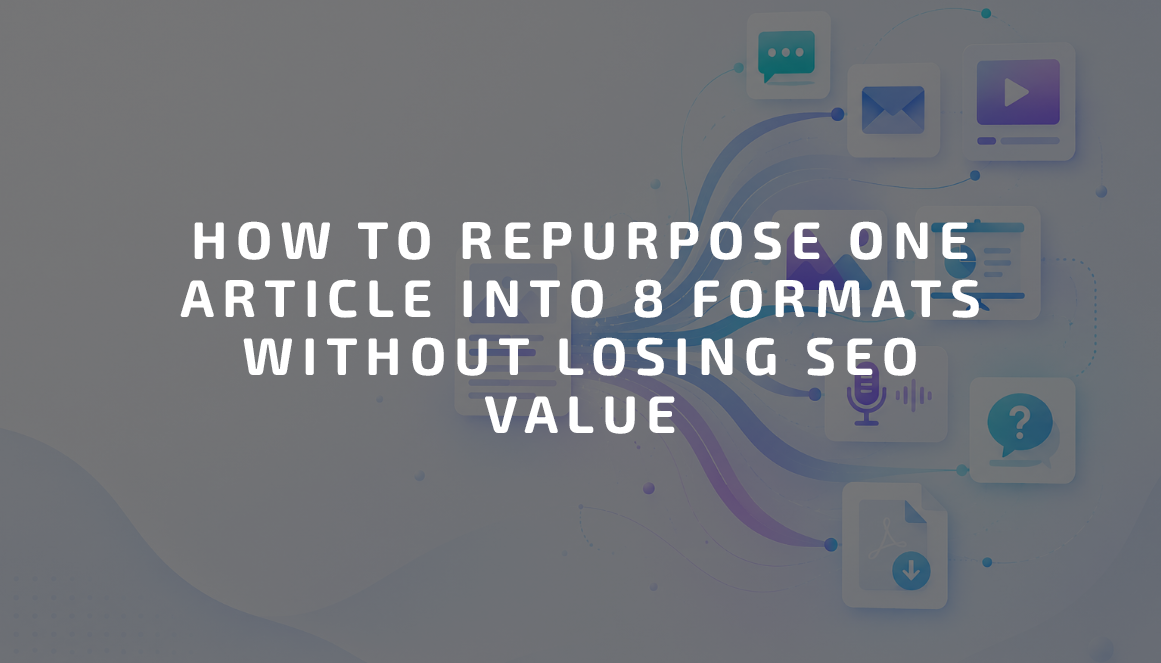
How to Repurpose One Article Into 8 Formats Without Losing SEO Value

how to repurpose one article into 8 formats
  • Does repurposing hurt the original article’s SEO? Not if each new format links back and avoids duplicating the exact page content verbatim on indexable pages.
  • Which formats give the most SEO return? Formats that generate backlinks, embeds, or new indexable pages — like infographics and slide decks — tend to add SEO value on top of the original.
  • Do I need to rewrite content for every format? No — reframe and restructure, don’t just copy-paste; each format should read like it was built for its channel.
  • What about duplicate content risk? It mainly applies to indexable web pages; social posts, videos, and PDFs typically don’t compete with the source article in search.
  • How much time does repurposing actually save? Most of the research and structure carries over, so new formats usually take a fraction of the original article’s production time.

Most teams write one article, publish it once, and move on. Meanwhile, the same piece of research and writing could quietly power a week’s worth of content across formats — if it’s repurposed in a way that protects, rather than dilutes, the SEO equity of the original.

Why the Source Article Should Stay the Anchor

Before splitting content into new formats, it helps to treat the original article as the canonical hub. Every repurposed piece should link back to it, and none of them should try to outrank it for the same primary keyword. This keeps search engines from getting confused about which page is the authoritative source, and it channels any new traffic or links back toward the page you actually want to rank.

The 8 Formats, and How to Adapt Without Duplicating

1. LinkedIn or X Thread

Break the article’s structure into a sequence of standalone points. Lead with the strongest insight, not the introduction — social audiences don’t scroll through a warm-up paragraph.

2. Email Newsletter Segment

Pull one specific angle rather than summarizing the whole piece. A newsletter works best when it feels like a focused take, with a link to “read the full breakdown” driving traffic back to the article.

3. Short-Form Video Script

Convert one section — usually the practical or example-driven part — into a script built around a hook, a problem, and a resolution. Video rarely needs the full argument, just the most visual or surprising point.

4. Infographic

Take any data, comparison, or step-by-step process from the article and turn it into a visual asset. Infographics are one of the highest-value repurposed formats because they attract embeds and backlinks from other sites, which flows authority back to the original page.

5. Slide Deck (SlideShare or LinkedIn Carousel)

Restructure the article’s headers into a slide outline. This format works well for B2B audiences and often ranks independently in search, extending the topic’s reach without competing for the same query.

6. Podcast Talking Points

Use the article as a discussion outline rather than a script. Podcasts add a layer of commentary and examples that didn’t exist in the original text, which is what keeps this format from feeling redundant.

7. FAQ Snippet for a Help Center or Chat Widget

Extract the article’s most specific, answerable questions and format them as short, standalone answers. This format supports customer-facing tools without needing to be indexed as a separate page.

8. Downloadable PDF Checklist or Template

Convert action-oriented sections — recommendations, steps, checklists — into a standalone resource. Gating this behind an email signup can turn one article into a lead-generation asset, something the original blog post format rarely does on its own.

Avoiding SEO Cannibalization

A few practical guardrails keep repurposed content from competing with the source article instead of supporting it:

  • Use canonical tags if a repurposed piece is republished on another domain or a syndication partner.
  • Vary the primary keyword focus — a LinkedIn post or PDF doesn’t need to target the exact keyword phrase the article ranks for.
  • Keep indexable repurposed pages thin on overlap. A slide deck or infographic page should stand on its own value (visual, structured), not just restate the article’s paragraphs.
  • Always link back to the source article, ideally with descriptive anchor text rather than generic “read more.”
  • Track rankings for the original URL after each new format goes live, to catch any unexpected drop in position early.

A Simple Repurposing Workflow

  1. Identify the 2–3 strongest sections of the article — usually data, examples, or step-by-step advice.
  2. Match each section to the format best suited to it (data → infographic, steps → checklist, insight → social post).
  3. Rewrite for the channel’s tone and length, not just trim the original text.
  4. Add a link back to the source article in every format that allows one.
  5. Publish on a staggered schedule rather than all at once, so each format has room to generate its own engagement.

FAQ

There's no fixed rule, but many teams wait until the article has had time to be indexed and gather initial engagement data, which helps identify which sections are worth repurposing first.
It's possible, but publishing the source article first generally makes it easier to establish it as the canonical reference point.
Lightly — social and video formats benefit from platform-specific keyword or hashtag research, which differs from traditional search keyword research.
Internally this isn't an SEO requirement, but consistent bylines can support topical authority signals over time.
Teams often use a mix of design tools for infographics, script-writing aids for video, and scheduling platforms to manage the staggered rollout.
Yes — older articles with existing rankings can be strong repurposing candidates, since they've already proven demand for the topic.
Look for increases in referring domains, branded search volume, or backlinks pointing to the original article after the new formats go live.
Boost Your Business with Expert Digital Marketing

Drive more traffic, leads, and sales with our customized digital marketing strategies. Our team of experts will craft a data-driven plan tailored to your business goals, budget, and target audience.

Leave a Reply

You may be interested in:

International SEO Services
The technique of optimizing webpages for search engines across different nations or languages is known as international SEO. It tries to reach a worldwide audience and target people in various locations, in contrast to traditional SEO, which concentrates on enhancing a website’s visibility in a particular place.
National SEO Services
Businesses are constantly looking for fresh ideas to boost their online visibility and draw in new clients in the ever-developing digital market. Search engine optimization (SEO) services that are offered nationally have become an important tactic for reaching these objectives.
SEO consultant for SaaS
As businesses continue to rely on their online presence to drive growth, the demand for SaaS SEO services is higher than ever. SaaS, an acronym for Software as a Service, is a cloud-based platform that provides businesses with a range of SEO tools and services.
SEO Consulting Services
SEO consultants are experts who focus on enhancing websites’ visibility and ranks in search engine results pages (SERPs). To boost organic search ranks, they assess and optimise website content, architecture, and backlink profiles using their knowledge and experience.
Keyword Research Services
Keyword research detects the words consumers use to find your company, products, and services. Keyword research aims to find relevant, high-traffic, low-competition keywords for your business to boost conversions
Technical SEO Services
Nowadays, most companies create online content primarily to improve their search engine rankings. If you can increase your rankings, you can improve your search engine rankings
Ecommerce SEO services
SEO is a low-cost marketing tool that can enhance sales and income. With so much competition, getting to the top might be tough.
SEO Audit Services
Trying to improve your site's search engine rankings but failing? Can't understand the reason? «Seologic» can give you a hand and offer our SEO audit services.
Link Building Services
Link building plays a very important role in SEO. Combined with a solid SEO technical base, great content, and a great user experience, links can also be very effective in promoting your brand.
Enterprise SEO Services
More than 90% of the user experience begins with search engines. As a result, high ranking in search results allows your business to connect with clients and customers who are looking to purchase your product or service.
Local SEO Services
Local search engine optimization (SEO) is a site optimization that is handcrafted for local businesses. The goal is to increase their visibility on search engines, increase traffic, attract leads and increase your income.
SEO Services
SEO stands for Search Engine Optimization. It is a digital marketing strategy aimed at improving the visibility and ranking of a website or web page in search engine results pages (SERPs) through the use of various techniques and best practices.

Client Testimonials

Get in Touch

×

Get in Touch