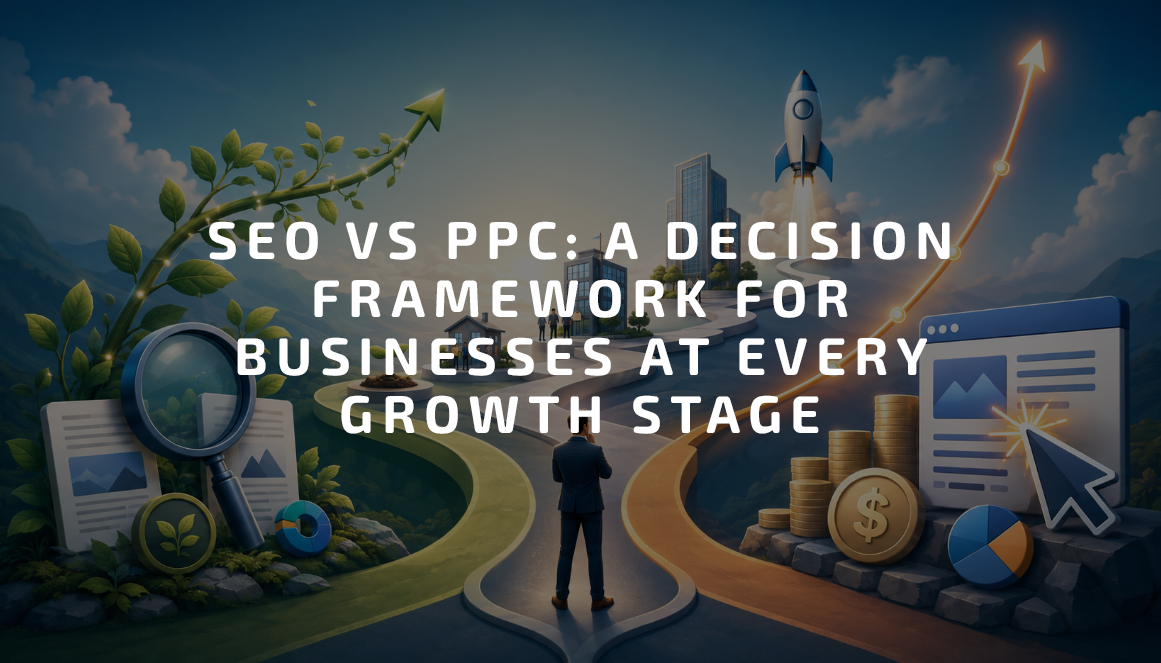
“Should we invest in SEO or PPC?” is usually the wrong question. The better one is: given where the business is right now — budget, timeline, and risk tolerance — which channel earns its cost faster, and when does the other one start paying off too?
Why Growth Stage Changes the Answer
A five-person startup validating a new product and a company scaling past $10M in revenue face different constraints. The startup needs signal fast and can’t wait six months for organic rankings to build. The scaling company has enough baseline traffic and budget to invest in compounding organic growth while still running paid campaigns for immediate revenue.
Treating SEO and PPC as a fixed either/or choice ignores this. The more useful approach is matching channel investment to what the business actually needs to prove or protect at each stage.
Framework by Growth Stage
Stage 1: Early / Pre-Product-Market Fit
At this stage, speed of learning matters more than cost efficiency.
- Lean toward PPC for fast validation of which messaging, offers, and audiences convert.
- Use PPC data to identify the keywords that actually drive purchase intent, not just traffic volume.
- Keep SEO efforts minimal but not zero — securing the brand name in search and publishing a handful of foundational pages avoids starting from nothing later.
Example: A new SaaS tool testing three pricing models can run PPC campaigns targeting each variant and learn which one converts within weeks, something organic testing couldn’t reveal that quickly.
Stage 2: Early Growth / Repeatable Sales Motion
Once there’s a proven offer, the goal shifts to building a durable acquisition base without full dependence on paid spend.
- Start scaling SEO using the highest-converting keywords identified through PPC data.
- Keep PPC running on the terms that are hardest to rank for organically or that convert best regardless of rank.
- Begin content production tied to the customer journey stages that PPC data revealed as high-intent.
Example: If PPC shows that “[category] pricing” converts at twice the rate of “[category] guide,” that’s the priority page for an SEO push, not a guess based on search volume alone.
Stage 3: Scaling / Established Market Presence
At this point, organic traffic should be carrying a growing share of total acquisition, which changes the economics of paid spend.
- Shift PPC budget toward defense and expansion — protecting branded terms from competitor bids, and testing new markets or products where SEO hasn’t yet built authority.
- Let SEO cover the bulk of steady-state, high-volume informational and commercial traffic.
- Reinvest some of the savings from reduced reliance on broad PPC campaigns into deeper content and technical SEO work.
Stage 4: Market Leader / Mature Brand
- SEO becomes a moat. Years of accumulated content, backlinks, and domain authority make it expensive for competitors to out-rank the business on core terms.
- PPC narrows to tactical use — new product launches, seasonal pushes, or geographic expansion where organic presence hasn’t caught up yet.
- Ongoing monitoring matters more than aggressive new investment in either channel at this stage.
A Simple Decision Checklist
Use this when deciding where to put the next marketing dollar:
- Do we need traffic this month, or can we wait six? Urgency points toward PPC; patience allows SEO to compound.
- Do we know which keywords convert, or are we guessing? If unsure, PPC is the faster way to find out.
- Is the budget one-time or ongoing? One-time budgets often suit PPC tests; ongoing budgets justify SEO’s slower payoff curve.
- How competitive is the market for our core terms? Highly competitive SEO landscapes may require PPC to stay visible while organic authority builds.
- What happens if paid budget disappears next quarter? If the answer is “traffic drops to zero,” that’s a signal SEO investment is overdue.
Common Mistakes Across Stages
- Treating PPC as a permanent traffic source instead of a bridge while SEO builds up.
- Starting SEO content with no PPC or conversion data, leading to pages that rank but don’t convert.
- Cutting PPC completely once SEO gains traction, losing visibility on competitive terms that still need paid defense.
- Ignoring PPC’s role as a research tool for what messaging and keywords actually drive revenue, not just traffic.


