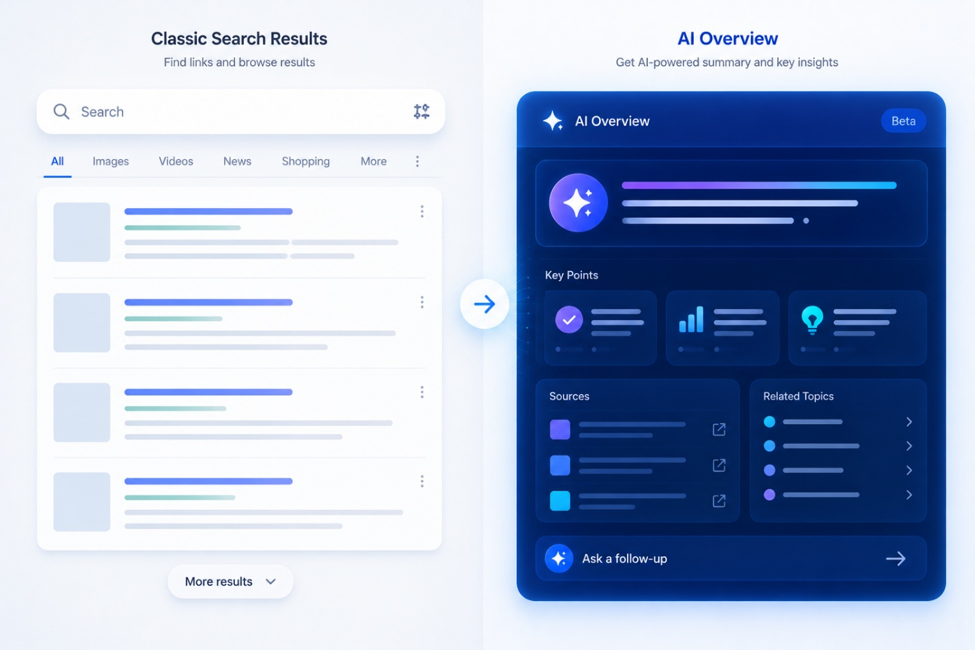
There’s a quiet competition happening on every search results page right now. Not between websites, but between pages that AI tools can confidently cite and pages they simply skip. The ranking factor most people underestimate in this competition isn’t backlinks or content length — it’s how clearly a page communicates what it is.
This is exactly what schema markup solves.
The Real Reason AI Tools Pick Certain Pages Over Others
AI-generated answers — whether in Google AI Overviews, Perplexity, or Bing Copilot — aren’t built from raw text. They’re built from interpreted content. The system reads a page, figures out what type of information it contains, and then decides whether that information answers the user’s question precisely enough to cite.
Here’s where most pages lose: the interpretation step. A page might have a brilliant answer buried in paragraph four of a 2,000-word post. Without structured markup, the AI has to guess that’s where the answer lives. With schema, you tell it directly.
Think of it as the difference between handing someone a neatly labeled filing cabinet versus a pile of loose documents. The cabinet wins — every time.
FAQPage Schema: The Closest Match to How AI Thinks
If you want to appear in AI-generated answers and you could only pick one schema type to implement this week, FAQPage is the one. The reason is structural: AI answer engines are fundamentally question-answering machines. FAQPage markup mirrors that exact format — a question, and a precise answer.
The practical impact is measurable. Pages that mark up Q&A content with FAQPage schema are regularly surfaced in Google’s AI Overviews for informational queries, often with direct attribution.
Concrete scenario: A personal finance blog covers the question “Does carrying a balance on a credit card help your credit score?” in a FAQ section. Without schema, that answer competes with dozens of similar paragraphs across the web. With FAQPage markup, the AI sees a cleanly declared question-answer pair and is far more likely to pull from it — and credit the source.
One important nuance: the answer text within FAQPage markup should be self-contained. Don’t write “See the section above for details.” Write as if the answer might be read completely out of context, because with AI extraction, it often will be.
HowTo Schema: Step-by-Step Content That AI Can Reproduce
There’s a category of search queries that almost always triggers AI-generated step lists: “how to” questions. “How to export contacts from Gmail,” “how to file a noise complaint,” “how to calculate gross margin” — these queries pull structured step content directly into the answer interface.
HowTo schema is built for exactly this. It lets you declare each step independently, with its own name, description, image, and time estimate. The result is content that AI tools don’t just find — they can reconstruct it cleanly in their own output format.
Example in practice: An HR software company writes a guide: “How to run payroll for the first time.” With HowTo schema applied to each of the eight steps, Bing Copilot can surface a condensed version of that guide when small business owners ask the question directly in chat. The company’s name appears as the source. No click required — but brand exposure and trust transfer happen anyway.
What to include in each step:
- A short, action-oriented name (“Add your employees’ details”)
- A clear description of what the user actually does
- Any tools or accounts required
- Time estimate if relevant
Article Schema with Author Markup: The Trust Signal People Overlook
AI systems have a credibility problem. They’ve been caught inventing sources, misattributing quotes, and pulling from low-quality pages. In response, the algorithms powering tools like Google AI Overviews have become increasingly selective about whose content they cite.
This is where Article schema paired with Person schema becomes an underrated advantage. Together, they establish that your content was written by an identifiable human expert, published on a specific date, and maintained over time. Those signals feed directly into E-E-A-T evaluation — the framework Google uses to assess content trustworthiness.
A medical clinic that marks up its health guides with Article schema, links those articles to a physician’s author profile with credentials, and updates the dateModified field regularly is sending a very different signal than an anonymous blog post from 2021.
The technical implementation is simple. What it communicates is not.
Organization Schema: Answering “Who Are You?” Before Anyone Asks
AI tools increasingly handle brand-level queries: “Is [company] still in business?”, “Who founded [brand]?”, “What does [company] actually do?” These questions pull from structured entity data, not page content.
Organization schema creates a factual anchor for your brand in the knowledge graph. Name, logo, founding date, social profiles, contact information — all of it becomes machine-readable and citable. For newer companies or businesses expanding into new markets, this schema type directly influences whether an AI tool can give an accurate answer about you at all.
A SaaS startup that implements Organization schema properly will have its correct information surfaced in brand queries. One that doesn’t may find AI tools citing outdated data from a third-party directory instead.
Product Schema with Reviews: Winning the Comparison Query
When someone asks an AI assistant “What’s the best accounting software for a 10-person team?”, the answer usually isn’t built from a single review article. It’s assembled from structured product data across multiple sources — pricing, feature sets, and aggregate ratings.
Product schema combined with AggregateRating markup positions your listing for exactly these queries. The AI isn’t just citing your page; it’s pulling your data points into a comparative framework alongside competitors. That’s a fundamentally different kind of visibility — one that can influence purchasing decisions before a user ever reaches a product comparison site.